AI and Learning
One of the biggest fears about artificial intelligence in education is that it will replace the need to learn, and with it the human ability to learn. I think of AI as a partner, much like a partner in a group project. It is fast and capable, and it also has blind spots and quirks. In any group, not every person is the right one to hand a given task to, and working well together means knowing who should do what. The same is true of AI. As educators, we have to be thoughtful about which work we hand to it and which work stays with our students.
I’m an enthusiastic proponent of experts using AI to build tools that deepen student engagement and learning. For me, the sweet spot is using AI to develop an advanced, specialized tool that enhances learning, rather than using it to do the work of learning on our behalf.
Ian Howell, Theodora Nestorova, and I talked about AI and teaching on the VocalFri Podcast in April 2026.
The AI Supported Voice Studio Portal
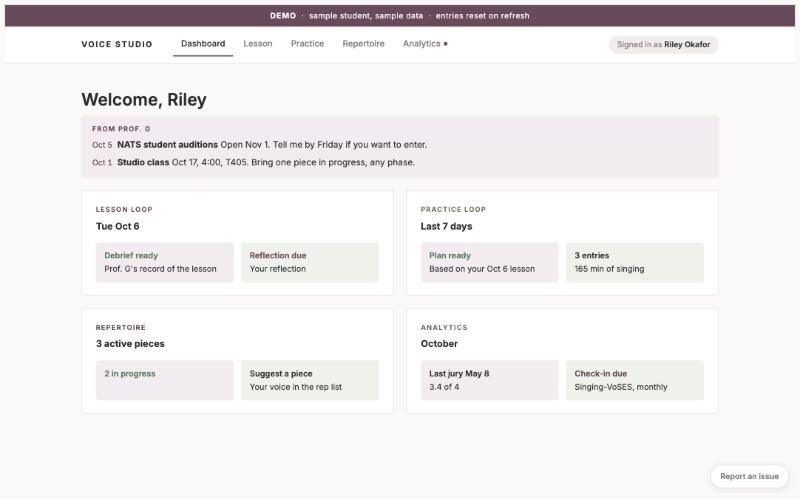 Dashboard
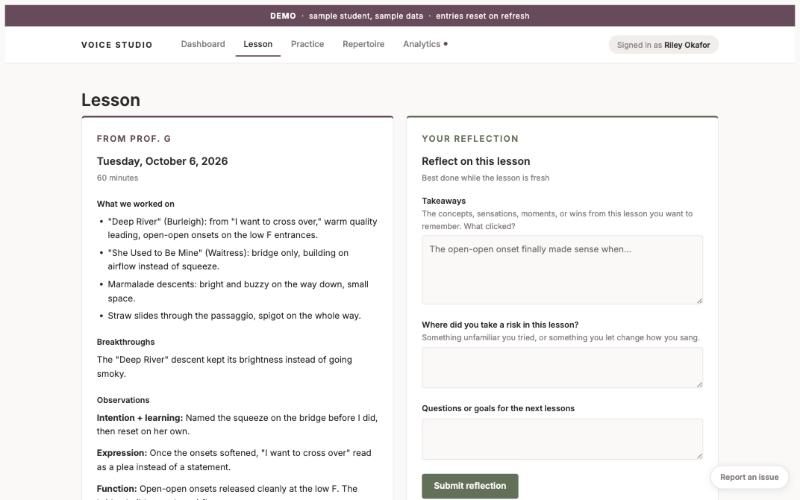 Lesson debrief and reflection
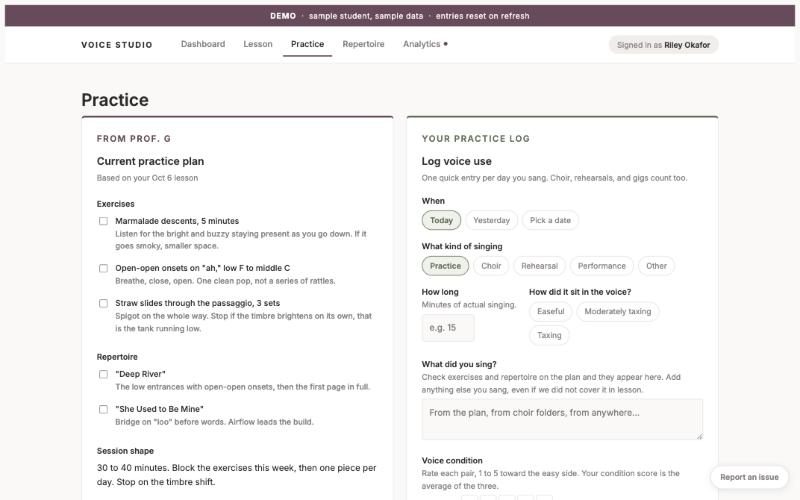 Practice plan and log
I built the portal for my own voice students, and I now use it with all of my private students. After each lesson it transcribes what happened and summarizes what we worked on and how the student responded. It writes an individual practice plan, and before the next lesson it prepares a brief for me from the student’s past lessons, reflections, and repertoire. Students see their progress, reflections, and plans on their own page. In 2026 the portal won the Pan American Vocology Association’s Best Microworkshop/ToolTalk award.
The portal is written in Python and uses the Claude API from Anthropic, with Supabase for the database and logins. The AI’s instructions are based on my teaching framework, including the co-investigation model, motor learning phases, an exercise taxonomy, and safety guidelines. The demo uses sample student data, so you can look around without an account.
The Vocal Pedagogy Research Archive
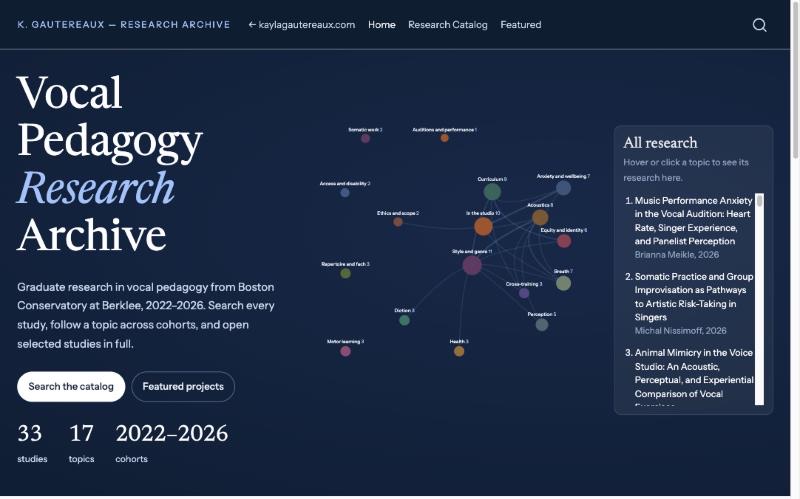
The archive holds the studies our graduate vocal pedagogy students have completed at Boston Conservatory at Berklee, 33 so far, from 2022 to 2026, across 17 topics. It gives any student beginning thesis research in vocal pedagogy, at Boston Conservatory or elsewhere, a clear starting point and models to learn from. Readers can search the catalog, follow a topic across cohorts, and explore the data in interactive figures. I built the archive with Claude, Anthropic’s AI model, and maintain it the same way.
The History of Vocal Pedagogy Timeline
In my History of Vocal Pedagogy seminar, each graduate student researches a pedagogue and adds events to a shared class timeline. With Claude, I turned the class’s contributions into an interactive timeline of 36 pedagogues, from Pier Francesco Tosi in the 1600s to the present, shown alongside major publications, musical periods, and world events. Readers can zoom in and turn each layer on or off, which makes it easier to see who was teaching at the same time and what was happening around them. Every student who contributed worked from widely available sources and gave consent for their contributions to be shared.
Consent, privacy, and data security
Of course, a clear understanding of the settings for data security and privacy is incredibly important, and so is informed consent.
Before a student uses the studio portal, they read and accept a consent form that explains what the portal does, how their information is stored and used, and what their rights are. Using the portal is voluntary and has no effect on a student’s standing in my studio, and students who would rather not use it can work out another arrangement with me. They can withdraw their consent or ask me to delete their data at any time.
In the portal, lesson audio is transcribed on my own computer and is never sent to an outside transcription service. Before a transcript goes to Claude, the student’s name is replaced with an identifier, and I have opted out of Anthropic using my data to train its models. Lesson records are kept in a protected database where each student can see only their own. I review everything the AI writes before a student sees it.
In the research archive, all data are confidentialized under Berklee’s institutional review board, and participants are identified only by number.
Consulting
I think teachers should be involved in building the AI tools they will use. I’m open to consulting and advisory work with companies building learning technology and with schools rethinking how teachers are trained.